
DSLR Wildlife Filmmaking
Why DSLR’s are Revolutionary
Filmmakers often say DSLR filmmaking is as revolutionary as the invention of color or 16mm film because it represents a huge leap forward in the quality of the image. Basically, a DSLR has a monstrous image sensor compared to the cameras filmmakers were using previously, about 20 to 30 times larger than that of the standard prosumer camcorder.
Here is a relative size comparison:
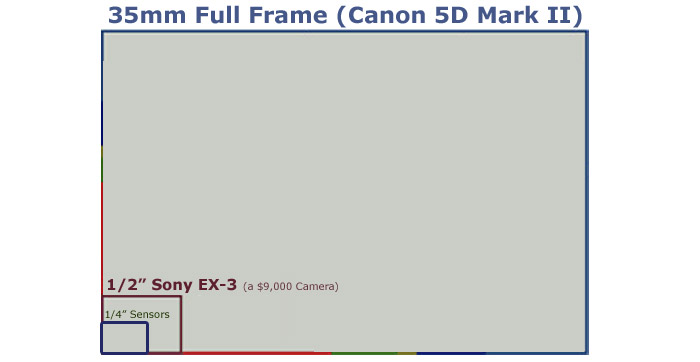
(We included the 1/2 inch sensor size of the $9000 Sony EX-3 so that you can get a feel for how much larger it really is.)
So what does this achieve? These are the main benefits.
- Shallow Depth of Field
For a professional-looking shot, the goal is to get the subject in focus while the background objects are blurred. This draws attention to the primary subject. - Greater Dynamic Range
When shooting in high-contrast light conditions, such as a sunny day under a half-shaded forest, you’ll want the bright spots and the shady spots to have resolution and clarity. The greater the dynamic range, the more detail you’ll be able to see in all brightness levels. 35mm film has always had one of the greatest dynamic ranges; DSLR cameras are catching up. - Great Low-light Sensitivity
If the sensor is larger, it’s going to register the incoming light better. After using an older camera to shoot indoors, filmmakers are amazed at how little light you need to shoot quality video with a DSLR. Most of the time you don’t even need extra light in indoor situations.
Making a Film with a DSLR
Again, while a DSLR was never intended to be a movie-making device, the revolutionary quality of its video at an affordable price make it worthwhile for filmmakers to use them with some creative workarounds, mainly in the audio department. For those filmmakers that use separate audio recorders, like Zooms, Tascam’s or Marantz’s, the workflow is much the same. Here are a few points to think about when shooting with a DSLR.
- Get an external microphone that can plug into your camera (using a mini-plug) or make sure to use an external audio recorder with a high-quality microphone.
- Bring a set of quality lenses for the camera. Prime lenses are the best quality for video. Image-stabilized lenses also greatly increase quality.
- Bring tripods, shoulder-mounts, or dollies to help stabilize the shots. These cameras are small and prone to jiggle.
- Try not to shoot while rapidly moving the camera. Because of the way the images are scanned, moving the camera quickly could make it look like the shot is wobbling.
The Benefits to Wildlife Filmmakers
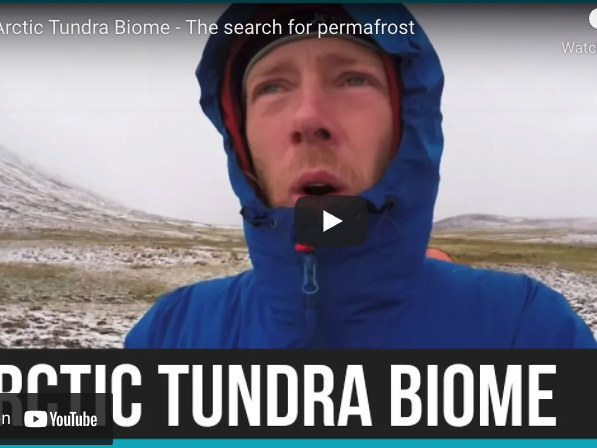
When shooting wildlife, you may not always be in an ideal scenario. Perhaps you’re in a dark and shady forest or you’re far off in the arctic where the conditions make it challenging to stay alive, let alone lug around a heavy camera. Sometimes you’re in a third-world country where pulling out a giant camera brings a lot of unwanted attention your way. In these scenarios, a small, inconspicuous, lightweight, light-sensitive DSLR is the way to go.
Getting shots in the understory of a rainforest is one of our new favorite things. Before, we needed to bring lights with us to shoot frogs or millipedes that were crawling on the forest floor. Now, as long as there is some small amount of light, there is absolutely no problem shooting these shots au naturale. It saves us from carrying a lot of extra weight into the jungle.
The lightweight factor can’t be emphasized enough. It’s a breeze to bring the camera on exploratory walks. If you see something that is worthy of a good video shot, you can pull out the camera and capture it.
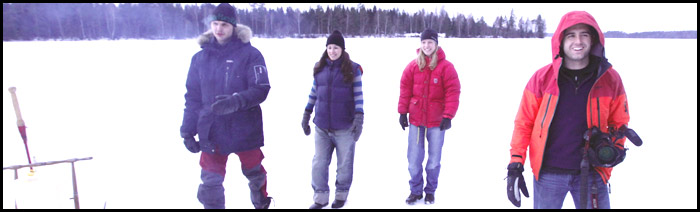
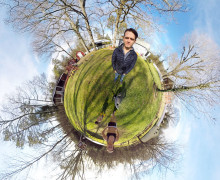
Finally, it is great to have diverse lens options. You can put on a fisheye lens to get a point of view shot or you can attach an extreme telephoto lens to capture some amazing animal behavior.
The Negatives to DSLR Filmmaking
The ultimate negative of the DSLR is a lack of audio functionality. The audio inputs on the camera make it difficult to shoot more than one person laved up at a time. There are ways to work around this, but it does make the filmmaking process a bit more difficult.
A DSLR BASICS TUTORIAL
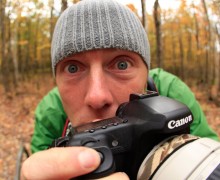
Jonas and I thought we’d share a quick tutorial about getting the most out of your DSLR.

2 thoughts on “DSLR Wildlife Filmmaking”
Comments are closed.



















Many thanks, you just saved me from making a mistake. Started using my dslr for making short wildlife films and am very pleased with the results.
Cheers.
Fantastic. Thanks for the comment Jim! Glad this helped.